


Overview
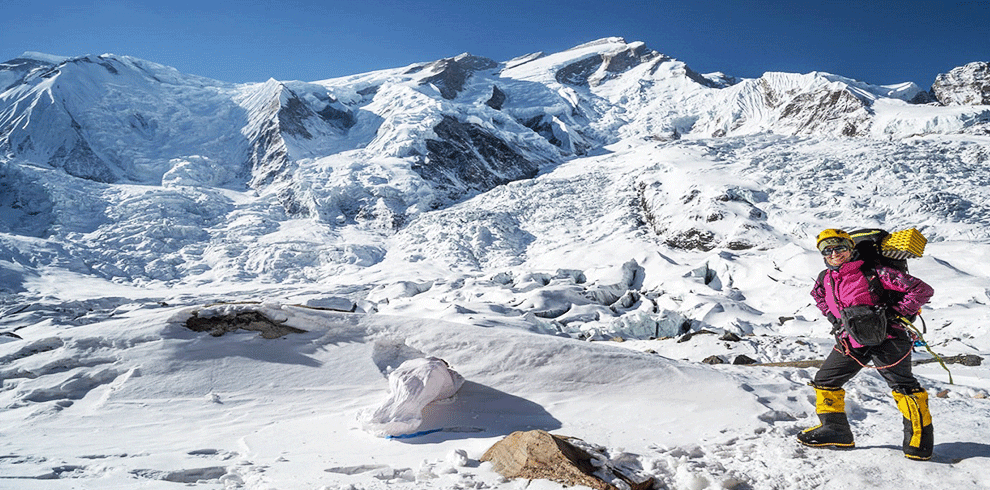
Mt.Dhaulagiri Himalayas is the seventh-highest peak in the world, Mt.Dhaulagiri Himalayas stands tall at an elevation of 8167 meters (26795 feet). This spectacular peak’s name means, benignly enough, the “White Mountain” but Dhaulagiri has come to be known as the mountain of storms and sorrows.
Mt. Dhaulagiri expedition is although the first of the 8000-meter peaks to be attempted by the French in 1950, who abandoned their bid in favor of Annapurna I, ironically it was the very last 8000-meter peak in Nepal to be climbed. In 1960 that a massive Swiss attempt was successful via the northeast spur. Supplied by a small glacier plane piloted by Ernst Saxer, the expedition finally ended the golden decade of Nepal’s giants by putting four Europeans and two Sherpas on the summit on 13th May, 960.
Mt. Dhaulagiri expedition was first sighted by the British surveyors in India in the early 1800s but reminded virtually unknown until a Swiss aerial survey in 1949. Mt. Dhaulagiri is also popular as This White Mountain and was first climbed in 1960 by the Swiss following the Northeast ridge. Dhaulagiri Himalayas is buttressed by five ridges and even up until the early 1980’s only the Northeast ridge had been successfully climbed. Dhaulagiri Himalayas is considered the most interesting peak among the eight thou sanders. At this moment there are more than six different routes established with variations and the possibility of more.
Dhaulagiri, a highly desirable and fascinating peak to climb, is the 6th highest peak in Nepal and the 7th highest peak of the world. It is located at the northwest corridor of Magdi District. It is one of the above 8000 meters peaks that lie entirely in Nepal. The word Dhaulagiri is derived from two Sanskrit words Dhawala and Giri which means “White Mountain”.
Mt. Dhaulagiri presents an extraordinary piece of climbing, a very demanding and daunting challenge. The views from the top affords a fantastic view of adjacent Dhaulgairi peaks, Annapurna, Macchapuchre, Manaslu and the Kali Gandaki valley including the deepest gorge in the world. 34 kilometres east from Dhaulagiri I, Annapurna I is located and in between these two peaks there exists a gorge known as Kaligandaki Gorge, which is the deepest gorge in the world. Kaligandaki River flows into this gorge.
Dhaulagiri region remained largely unknown till a Swiss aerial survey occurred in 1949. The French Annapurna expedition team was granted permission in 1950 to climb either Annapurna or Dhaulagiri, but they decided to climb Annapurna at that time. The first successful ascent of Dhaulagiri Mountain was made on 13th May, 1960 by eight members of a Swiss/Austrian expedition team led by Kurt Diemberger including Peter Diener, Ernst Forrer, Albin Schelbert, Nyima Dorji and Nawang Dorji. Before the first successful summit of Dhaulagiri in 1960, four other expedition teams were unable to keep their foot on the top.
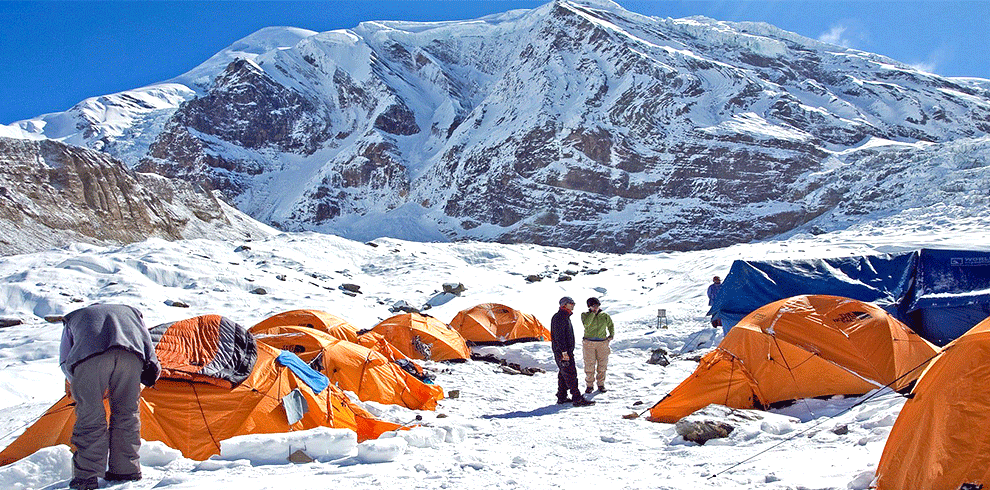
Dhaulagiri expedition requires about four weeks of time including 7-10 days trekking reaching Base Camp located at an altitude of 4748 m. The first camp is located at 5850 meters, second camp is at 6400 meters and third camp is at 7400 meters. Multiple routes are available to scale Dhaulagiri Mountain. However, climbing Dhaulagiri via the North East Ridge is considered as a standard route. It consists of three High Camps above the Base Camp. It is one of the difficult and technical mountains that require special climbing/mountaineering skills. Because of it, only veteran mountaineers keep their eyes on Dhaulagiri Mountain. There are two routes to begin your journey to Base Camp. You can either drive to Marpha and start trekking from there or drive to Darbang from west and start trekking from there. The latter one is more common and popular as it takes few more days which is good for acclimatization. The time duration to complete Dhaulagiri expedition is about 7 weeks for both routes from your arrival to departure.
Route
Dhaulagiri Trekking starts from Beni bank of Kali Gandaki and Myagdi Khola seasonal road heading to Darbang, follow the Myagdi Khola westwards to Darbang and turn north on a tiny trail that leads through forests into the high country. Trekking trail leads to Italian Base Camp then heading to Dhaulagiri Base Camp.
Normal route is via Northeast Ridge, the original route climbed by Swiss-Austrian expedition in 1960. Typically 4 upper camps will be set up for the climbing. The Advance Base Camp is established at 5,300m, just to deposit the gear but it will not be used as an overnight camp due to avalanche danger. Hence the Base Camp 4750m will be used as Advance Base Camp for Accommodation and meal purpose. Camp 1, 5,900m on the Col east from the ABC. Along this trail you will suffer for some avalanche risk as well as crevasses danger. Camp 2, 6,400m, which is reached from camp 1 with some steep climbing sections. The ropes shall be fixed and you need some technical climbing experience with the support of your climbing Sherpa. You need 1 technical Ice Axe as usual. When you have private Sherpa it is not mandatory to take 2 technical Ice Axes. One will work. Camp 3, (7400m) will be located towards the west with steep ice and snow climbing along the ridge of Mountain. Gradually ups and down will be done several times. You climb towards the East Ridge, where you likely experience strong wind conditions before reaching camp 3. This is the most difficult part of the climb. From camp 3 we make direct push for the summit and return to camp 3 if the conditions will allow us. With difficult conditions the fallback is to set up Camp IV at 7,900m in order to attempt another summit push the next day.
Alternative itinerary for Dhaulagiri expedition
Day 01: Arrival at Tribhuvan International Airport, Kathmandu.
On your arrival at Tribhuvan International Airport, you will be met and welcomed by our airport representative. You will be greeted traditionally with flower garlands. The representative will then take you to your hotel where you will be served welcome drinks. In the afternoon, you can take a stroll around and visit shops, restaurants and bars. Stay overnight at the hotel in Kathmandu.
Day 02: Trip preparation and city tour of Kathmandu or Patan and Bhaktapur.
Today, you will visit popular world heritage monuments in Kathmandu including Kathmandu Durbar Square, Boudhanath, Swoyambhunath, and Pashupatinath. Alternatively, you can also choose Bhakatapur and Patan sightseeing. By late afternoon, you will drive back to your hotel. Stay overnight at a hotel in Kathmandu.
Day 03: Final Preparation day.
Final preparation day in Kathmandu for expedition. Stay overnight at hotel in Kathmandu.
Day 04: Drive from Kathmandu to Pokhara (914m.) takes about seven hours.
After early morning breakfast, you will be picked up from the hotel and taken to the tourist bus station. Drive from Kathmandu to Pokhara (914m.) takes about seven hours. The drive will take most of our morning time, leaving much of the afternoon to get a warm glimpse of Pokhara Valley and its beauty. If you choose to fly, you can reach Pokhara in 25 minutes. There are several flights from morning to afternoon available from Kathmandu to Pokhara.
Pokhara is the tourist’s paradise with full of natural as well as cultural heritage sites such as lakes, caves, Buddhist monasteries and Hindu temples along with the magnificent views of Lamjung Himal, Annapurna, Dhaulagiri and many other mountain peaks. Stay overnight at hotel in Pokhara.
Day 05: Drive from Pokhara (915 m.) to Marpha (2670m) takes about 4 hours.
After breakfast, you will drive from Pokhara (915 m.) to Marpha (2670m) takes about 4 hours. Stay overnight at lodge.
Day 06: Rest day at Marpha for acclimatization. Today, we make sure all equipments are there for camping and climbing. Stay overnight at lodge.
Day 07: Trek from Marpha to Yak Kharka (3680 m). Camping starts from today for meals and accommodation. Stay overnight at camp.
Day 08: Trek from Kalopani to Hidden Valley. Stay overnight at camp.
Day 09: Trek from Hidden Valley to Dhaulagiri Base Camp. Stay overnight at camp.
Day 10-40: Climbing period (Base Camp – Summit 8167 m – Base Camp) of Dhaulagiri Mountain.
Three high camps will be made before you go for final summit of world’s 7th highest peak. Stay all nights in camp.
Day 41: Trek from Dhaulagiri Base Camp to Hidden valley via French pass (5010m.) takes about 5 hours.
You trek along trail covered with ice and soft snow. The stunning views of the Dhaulagiri range completely enchant you. Stay overnight at camp.
Day 42: Trek from Hidden Valley (5200m) to Yak Kharka takes about seven hours.
You traverse avalanche-prone slopes and then take on the steep descent to Yak Kharka. This day you trek through bare land for some distance. Stay overnight in camp.
Day 43: Trek from Yak Kharka to Marpha (2670m.) takes about five hours.
This day the trail moves downhill until Marpha. On the way you pass small forests of juniper and other local vegetation. You will be accompanied by the splendid views of Nilgiri, Annapurna and rocky hills. Stay overnight at camp/lodge.
Day 44: Drive from Marpha to Pokhara by Jeep/Bus. Stay overnight at hotel in Pokhara.
Day 45: Drive from Pokhara to Kathmandu that takes about seven hours.
After breakfast early morning, drive from Pokhara to Kathmandu that takes about seven hours. En route, you will enjoy the mountain views, green sceneries, rice terrace fields, vegetable fields and people being engaged in their daily life activities. If you choose to fly back to Kathmandu, it takes about 25 minutes. There are several flights from Kathmandu to Pokhara from morning to afternoon. Stay overnight at hotel in Kathmandu.
Day 46: Free day in Kathmandu for shopping and recreation. Stay overnight at hotel in Kathmandu.
Day 47: Departure
As per your flight schedule, our airport representative will transfer from your hotel to the airport for your final departure.
Climbing permit cost
| Mountains | Spring | Autumn | Summer |
| Dhaulagiri (8167M) | $ 1800 | $ 900 | $ 450 |
Dhaulagiri Expedition cost details of Nepalgram Adventure
47 days trekking and climbing programs. Include Lodge, tent accommodations, Breakfasts, Lunch, Dinners, Porters’ High climbing guide & cook.
The price also includes fixed rope, main rope, ices crow, snow bar, ice hammer & all the group gears need while climbing the peak.
Hotel in Kathmandu as per our itinerary is included. Transport, Climbing permit and insurance is included in the cost for Dhaulagiri Expedition.
We assure kind hearted and experienced staff who knows how-to trace the route on glacier route, high pass route, and how to fix the rope for ice climbing, and how to climb the Dhaulagiri Expedition with minimal risk and precisely successful pattern.
Looking forward
After a rich Himalayan trekking experience, our Dhaulagiri Expedition will end Marpha.
Nepalgram Adventure is glade to design your Dhaulagiri Expedition in Nepal as a complete Nepal travels with our experienced climbing/Trekking guides and expert staff for your satisfaction.
Major Attraction of Dhaulagiri Expedition
- The 7th highest mountain in the world
- An adventurous and challenging mountain climbing in Nepal
- A perfect expedition trip for climbers who want a more intense experience of the high mountains
- Passing through terraced middle hills of Nepal, explore local customs, a way of life, exploring villages and different ethnic groups





 Big Group? We can help safer